


How to Improve the Visibility of Industrial Assets with IBM Maximo
In the fast-paced Industry 4.0 ecosystem, asset management for achieving day-to-day operational success has become a monumental task. Industrial plants face a constant challenge: consolidating information from scattered sources and resolving issues in real time while trying to innovate under the pressure of high costs caused by unplanned downtime, shortages of skilled personnel, and the urgent need for decarbonization.
Traditionally, asset visibility has been a “black box.” Many companies, even those with annual revenues of tens of millions of euros, continue to operate under a reactive maintenance model, relying on Excel spreadsheets that produce outdated data and conceal the natural wear and tear of machinery.
However, technology has changed the rules of the game. IBM Maximo Application Suite (MAS) 9.0 is not simply industrial asset management software; it is a comprehensive AI-powered industrial maintenance platform that turns an ocean of data into real operational efficiency.
IBM Maximo Application Suite provides a comprehensive asset management view by connecting maintenance, operations, condition data, planning, reliability, and asset lifecycle analysis. Its value lies not only in recording information, but in turning that information into operational, technical, and financial decisions.
When the plant operates with incomplete information
In sectors such as food and beverage, manufacturing, chemicals, metalworking, or automotive, operations depend directly on the condition of machinery. A packaging line, pump, compressor, boiler, refrigeration system, or conveyor is not simply a piece of equipment: it is a productive asset that directly affects plant continuity.
However, it is still common to find companies managing work orders, intervention histories, technical inventories, or spare parts using Excel, paper, emails, or systems that do not communicate with one another. Even when an ERP is in place, many day-to-day decisions still depend on manual, incomplete, or difficult-to-use information.
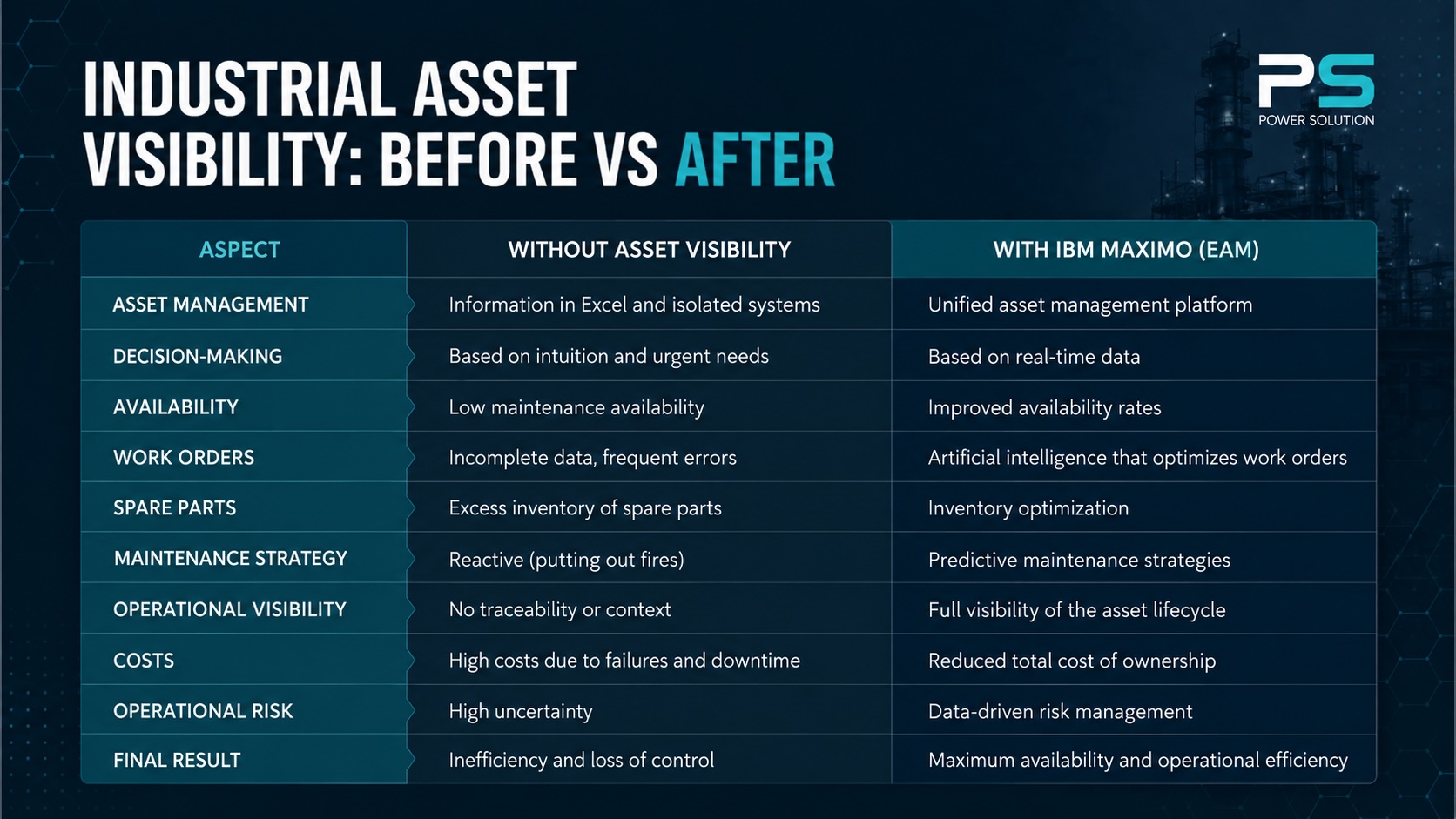
The consequence is clear: decisions are made too late, priorities are determined by urgency, traceability is lost, and the high costs associated with downtime, rework, emergency purchases, and inefficient use of technical resources increase.
Effective asset management makes it possible to move away from this reactive approach toward a model in which every piece of equipment has context, history, criticality, and operational data available to the people responsible for making decisions.
The end of the “firefighting” era
One of the biggest pain points in processing companies and manufacturing operations is the lack of visibility. When a manager does not have a clear overview, decisions are based on assumptions, affecting the plant’s availability rates.
The hidden costs of poor visibility:
- Unplanned downtime: The financial impact of a breakdown is often exponentially greater than the cost of the repair itself, compromising maximum availability.
- Inefficient maintenance: Performing calendar-based interventions on equipment that does not need them wastes labor and spare parts.
- Insufficient risk management: Without data, it is impossible to anticipate catastrophic failures that affect safety and budgets.
By adopting better maintenance strategies, companies evolve from reactive to predictive maintenance. Implementing a solid methodology is the first step toward preventing unexpected downtime and ensuring that industrial assets operate at peak performance.
AI and IoT Devices: Real-Time Intelligence
Industrial asset visibility is not simply about knowing how many machines exist or when the last intervention took place. It means understanding the actual behavior of equipment, its recurring failures, its impact on production, its consumption of resources, its technical condition, and its contribution to the overall performance of the operation.
When a company does not have this information, difficult questions arise: should an asset be repaired or replaced? Which asset should be modernized first? Which spare part should always be available? Which work order is truly the highest priority? Which failure keeps recurring and has still not been analyzed?
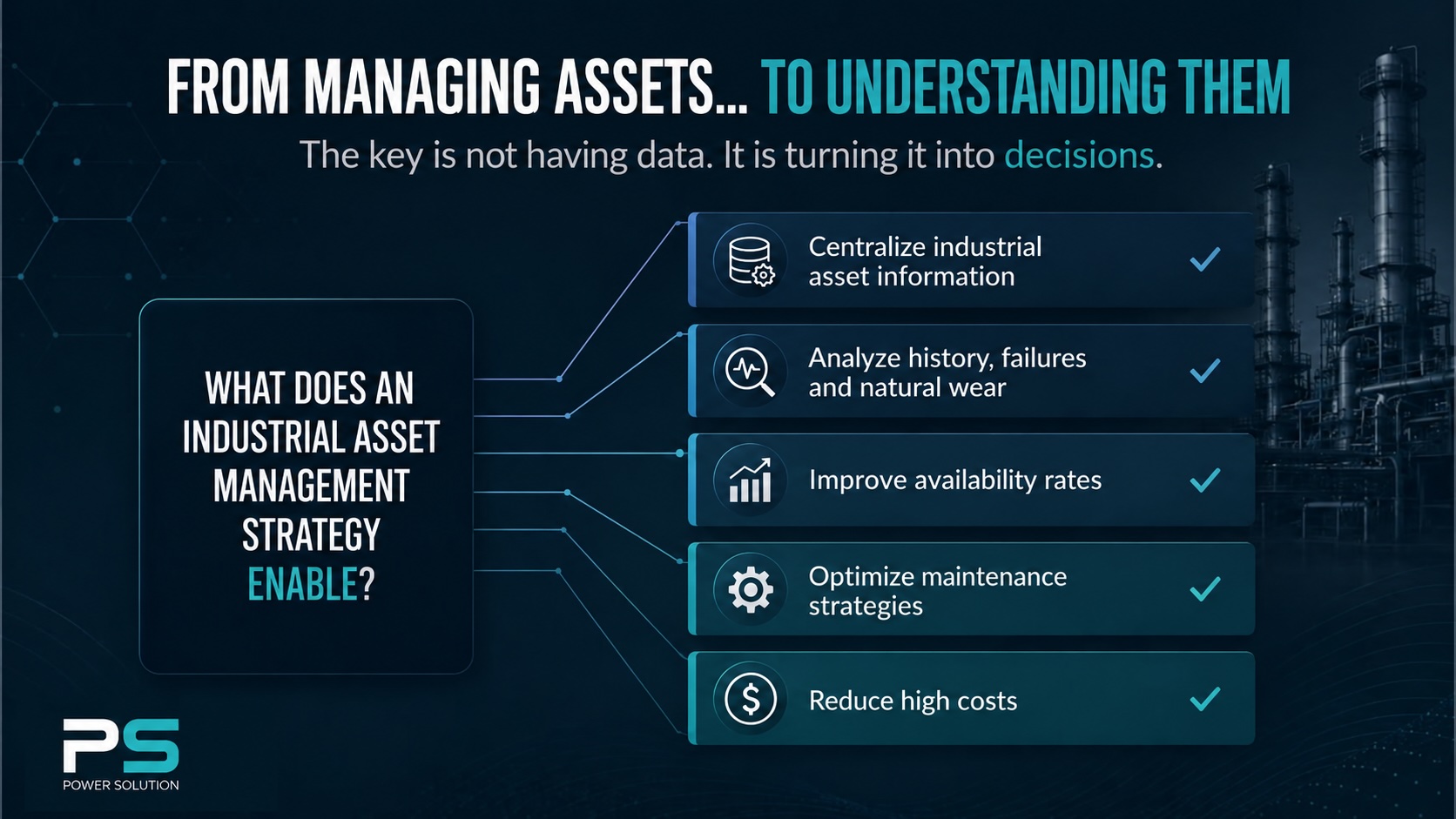
IBM Maximo helps answer these questions through data-driven asset management. The platform centralizes technical information, maintenance history, work orders, planning, inventory, inspections, and condition data to create a reliable source for decision-making.
This is especially important for improving maintenance availability, because it is not enough to intervene faster: you need to know what to work on, when to intervene, and which resources are required.
The latest version of Maximo uses IBM watsonx™ generative AI to improve asset management. By integrating IoT devices and OT devices, the platform captures data directly from the factory floor.
How many hours does a team lose assigning failure codes without sufficient information? AI analyzes descriptions and automatically recommends the most likely codes. This monitoring technology makes it possible to:
- Accelerate approval of work orders.
- Identify the source of the problem before sending a technician.
- Improve preventive maintenance based on real data rather than estimates.
Complete Visibility: OT, IT, and Control Systems
To achieve high levels of efficiency, it is essential to connect industrial control systems with the management layer. Modern asset management requires monitoring equipment to continuously transmit data about machine health.
Thanks to network monitoring technologies, Maximo makes it possible to monitor the condition of industrial assets at remote locations. This improves the availability indicator by enabling early intervention when any anomaly is detected by the monitoring equipment.
Reliability and Availability Strategies
Determining when an asset should be repaired or replaced is a critical financial decision. With IBM asset management, organizations gain access to a library of failure modes that takes into account the natural wear and tear of each component.
The impact on profitability:
- Maintenance availability: A well-managed system ensures that equipment is ready when production requires it.
- Improved availability rates: By reducing downtime, the return on investment of industrial assets is maximized.
- Risk management: Vulnerabilities in the supply chain and critical infrastructure are identified.
The path toward efficiency in industrial asset management
Asset management is not simply about knowing where a machine is located; it is about understanding its lifecycle to ensure maximum availability. By implementing new maintenance strategies supported by intelligent monitoring equipment, operational efficiency stops being a distant goal and becomes an everyday reality.
It is essential to work with a reliable provider that understands the challenges of modern preventive maintenance. At Power Solution, we help companies implement IBM asset management so that they stop viewing their infrastructure as an expense and start seeing it as their greatest competitive advantage.
Maintenance availability is the metric that separates industry leaders from the rest. With the right asset management approach, you can ensure that your availability rates remain at the highest levels while protecting your long-term investment.
Are you ready to improve maintenance availability and achieve higher availability rates with IBM Maximo? The future of your plant depends on the visibility you have today. Contact an expert advisor now